


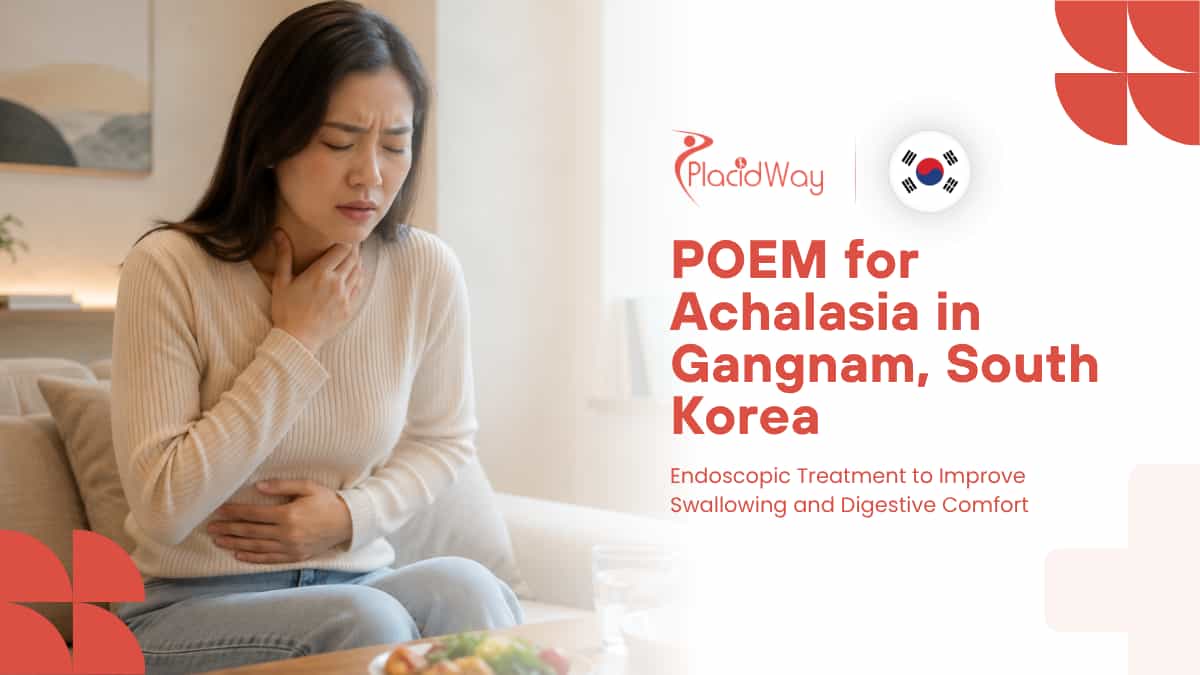
Struggling to swallow shouldn’t mean you have to swallow the reality of major open surgery just to enjoy a meal again. Peroral Endoscopic Myotomy (POEM) is a highly precise, minimally invasive procedure that treats achalasia by relaxing your esophageal muscles from the inside, naturally restoring your ability to eat comfortably. While Gangnam is globally famous for its flawless K-Beauty transformations, patients from the United States, Singapore, Japan, and Taiwan are increasingly traveling to this district to access top-tier gastrointestinal specialists equipped with cutting-edge endoscopic technology. You get to benefit from South Korea’s world-class medical tourism infrastructure, receiving advanced treatment at a fraction of Western healthcare costs.
Essential Treatment Insights at a Glance
- ✓ Accessible Pricing: Packages typically range from $300 to $2,000, offering massive savings compared to North American or European healthcare systems.
- ✓ Global Accreditations: Procedures are performed in Joint Commission International (JCI) accredited and Korean Accreditation Program for Hospitals Serving Foreign Patients (KAHF) certified facilities.
- ✓ The K-Beauty Infrastructure Advantage: High-tech clinical precision, seamless VIP patient services, and dedicated translation teams built for the aesthetic boom are now applied to serious gastrointestinal care.
- ✓ Incision-Free Approach: Because the myotomy is performed entirely through the mouth using a specialized endoscope, there are absolutely no external incisions or visible scars.
- ✓ Rapid Recovery Protocol: Patients generally experience minimal post-operative pain, requiring only a brief 1 to 2-night hospital stay before transitioning to a guided liquid diet.
Why International Patients Choose Gangnam for Achalasia Relief
Gangnam is far more than trendy cafes and pop culture; it operates as a sophisticated hub for medical innovation and precision endoscopy. Patients across the globe are skipping local waiting lists and soaring medical bills to seek out South Korea's highly experienced gastroenterologists.
- United States Patients Seeking Fair Pricing: American patients frequently travel here to escape out-of-pocket costs that can easily top $20,000 at home, securing the exact same cutting-edge endoscopic care for a fraction of the price.
- Japanese and Taiwanese Medical Tourists: Given the close geographical proximity, patients from Japan and Taiwan take advantage of short flights to access Korea's high volume of gastrointestinal expertise and incredibly rapid appointment scheduling.
- Singaporean Patients Looking for Value: While Singapore boasts excellent healthcare, the high cost of living translates to expensive private medical care; Gangnam offers equal clinical excellence with a much more patient-friendly price tag.
- Chinese Patients Desiring Premium Care: Affluent medical travelers from China flock to Gangnam to utilize dedicated VIP international clinics, ensuring they receive uninterrupted, top-tier medical attention with flawless Mandarin translation services.
- Thailand Residents Accessing Niche Specialists: While Thailand is a major medical tourism hub itself, patients facing rare conditions like achalasia often seek out the hyper-specialized endoscopic training that South Korean physicians are renowned for globally.
How the K-Beauty Boom Benefits Gastrointestinal Patients
It might sound strange to bring up cosmetic trends when you are looking for a solution to a serious swallowing disorder. However, the massive global demand for K-Beauty essentially built the gold-standard medical infrastructure you will rely on during your POEM procedure.
- Flawless International Patient Coordination: The aesthetic industry forced clinics to perfect the art of international logistics, meaning your airport transfers, hotel bookings, and medical appointments are handled with hotel-like precision.
- State-of-the-Art Clinic Environments: Thanks to the high standards demanded by beauty tourists, medical facilities in Gangnam look and feel more like luxury wellness retreats than sterile, intimidating hospitals.
- Seamless Translation Services: Because the district caters to global beauty seekers, full-time, medically trained interpreters for English, Mandarin, Japanese, and Thai are standard staff members at major hospitals.
- Rapid Adoption of Micro-Technology: The obsession with minimally invasive cosmetic procedures created a wider medical culture in Korea that heavily invests in advanced, non-surgical tools—perfect for endoscopic treatments like POEM.
- Focus on Patient Comfort and Aftercare: The high-touch customer service developed for aesthetic recovery has trickled down to general surgery, ensuring you receive attentive, compassionate nursing care while you recover.
Global Cost Comparison for POEM Surgery
Medical travel requires careful financial planning. The table below illustrates why so many patients are choosing South Korea over other developed healthcare markets for this specialized procedure.
| Country | Estimated Cost Range (USD) |
|---|---|
| United States | $15,000 - $25,000+ |
| Singapore | $10,000 - $18,000 |
| Japan | $5,000 - $9,000 |
| Gangnam, South Korea | $300 - $2,000 |
Note: The pricing listed above for South Korea is an estimated cost range based on standard packages. Final procedural costs are pending a comprehensive medical assessment, the specific severity of your achalasia, and your required length of hospital stay.
What is Included in Your Treatment Package
- Pre-operative consultation with a board-certified gastroenterologist.
- Standard pre-operative diagnostic blood panels and basic EKG.
- The Peroral Endoscopic Myotomy (POEM) procedure using advanced endoscopy.
- General anesthesia and continuous anesthesiologist monitoring.
- Standard hospital stay (typically 1 to 2 nights) in a private or semi-private room.
- Post-operative nursing care and daily physician rounding.
- In-hospital translation services for your medical appointments.
- Dietary counseling for your post-procedure liquid and soft food transition.
Services Excluded from the Base Package
- International airfare and travel insurance.
- Hotel accommodations for recovery days outside the hospital.
- Complex pre-operative diagnostics (e.g., high-resolution manometry if not brought from home).
- Treatments for unforeseen medical complications or unrelated health issues.
- Take-home prescription medications (usually a nominal out-of-pocket pharmacy fee).
- Airport pickup and drop-off (can be arranged for an additional fee).
Medical Records Needed for Your Preliminary Assessment
To ensure our specialists can accurately evaluate your candidacy for POEM before you book a flight, please prepare the following medical documents.
- High-Resolution Esophageal Manometry: This is crucial to confirm the specific type and severity of your achalasia.
- Recent Upper Endoscopy (EGD) Reports: Complete with biopsy results to rule out other esophageal conditions or structural issues.
- Barium Swallow Study (Esophagogram): Imaging or detailed reports showing the dilation and shape of your esophagus.
- Complete Medical History: A detailed list of your current medications, known allergies, and records of any previous abdominal or esophageal surgeries.
- Recent Blood Work: Standard complete blood count (CBC) and basic metabolic panel taken within the last 3-6 months, if available.
Seamless Medical Travel: Navigating Gangnam for International Patients
Planning a medical trip can feel overwhelming, but South Korea has streamlined the process for foreign visitors. Here is how patients from various regions manage their journey to Seoul.
- Frictionless Visa Entry: Many target demographics, including citizens from the US, Japan, Singapore, and Taiwan, enjoy visa-free entry for short stays, making rapid medical travel incredibly easy to organize.
- Airport to Clinic Connectivity: Incheon International Airport is highly connected; patients can take the comfortable Airport Railroad Express (AREX) or a direct luxury limousine bus straight to the heart of Gangnam.
- Medical Visa Options for Extended Stays: If your treatment plan requires a longer recovery, patients from China and Thailand can easily apply for the specialized C-3-3 Medical Tourist Visa with an invitation letter from the clinic.
- Accommodation Proximity: Gangnam offers a vast array of accommodations ranging from budget-friendly Airbnbs to luxury hotels, most located within a five-minute walking distance of major medical centers.
- Navigating the Neighborhood: The area is heavily mapped in English and Chinese on apps like Naver Map, making it stress-free to find pharmacies, convenience stores, and specialized porridge shops for your post-op diet.
The Endoscopic Revolution: Why POEM is the Modern Standard
Achalasia treatment has evolved drastically over the last decade. Here is why the medical community and informed patients are leaving older surgical methods behind in favor of this endoscopic approach.
- Replacing Laparoscopic Heller Myotomy: Traditionally, surgeons had to make multiple incisions in the abdomen to access the esophagus. POEM achieves the exact same muscle release entirely through the mouth, minimizing trauma.
- Superior Symptom Relief: Clinical studies consistently show that POEM offers relief rates comparable to or better than traditional surgery, providing long-lasting solutions to debilitating swallowing issues.
- Customizable Treatment Length: Because the doctor is working from the inside, they can tailor the length of the muscle cut specifically to your anatomy, which is particularly useful for Type 3 (spastic) achalasia.
- Zero External Scarring: For patients concerned about aesthetics or abdominal wound care, POEM leaves the body visually untouched, significantly reducing the risk of exterior surgical site infections.
- The Fast Track to Normalcy: Without abdominal incisions to heal, the body's inflammatory response is much lower, allowing patients to get out of bed and begin a liquid diet almost immediately after the procedure.
Pre-Flight and Post-Op: Planning Your Recovery Timeline in Seoul
Understanding your day-by-day itinerary takes the anxiety out of medical travel. Here is a realistic timeline of what to expect from your arrival in South Korea to your flight back home.
- Days 1-2 (Arrival and Preparation): You will arrive in Seoul, settle into your accommodation, and attend a pre-operative consultation at the clinic to finalize blood work and review the surgical plan.
- Day 3 (The Procedure): You will be admitted to the hospital, placed under general anesthesia, and undergo the POEM procedure, which typically takes between 1 to 3 hours depending on complexity.
- Days 4-5 (Inpatient Observation): You will remain in the hospital for monitoring. Doctors will likely perform a barium swallow X-ray to ensure the esophagus is healing correctly and there are no leaks before allowing you to drink liquids.
- Days 6-8 (Outpatient Recovery): Discharged to your hotel, you will rest and strictly adhere to a clear liquid diet. Gangnam's numerous wellness cafes and convenience stores make it easy to source clear broths and special juices.
- Day 9 (Final Check-up and Departure): After a final follow-up appointment with your gastroenterologist to ensure you are healing well, you will be cleared to safely board your flight back home.
Language, Culture, and Care: What to Expect Inside a Gangnam Clinic
Stepping into a foreign hospital can feel intimidating, but Gangnam’s international clinics are specifically designed to make you feel comfortable, understood, and meticulously cared for.
- Dedicated Medical Coordinators: From the moment you inquire, a dedicated coordinator acts as your personal advocate, handling your schedule and translating medical jargon into plain, understandable language.
- Culturally Sensitive Care Teams: Nurses and staff in major international centers are trained to understand the cultural nuances and dietary preferences of patients from the US, China, Japan, and Southeast Asia.
- Transparent Communication: Korean medical culture in premium international centers places a high value on transparency; your doctor will walk you through every step, risk, and expected outcome clearly before you sign anything.
- Modern Amenities: Hospital rooms often mimic high-end hotel rooms, featuring high-speed Wi-Fi, comfortable guest seating for your travel companion, and pristine private bathrooms.
- Post-Discharge Support Systems: Care doesn't end when you leave the building; clinics utilize messaging apps like WhatsApp, WeChat, or LINE to check on your recovery daily while you remain in Seoul.
Common Patient Questions About Endoscopic Achalasia Treatment
1. Is the POEM procedure painful?
Because the procedure is performed entirely internally without cutting skin or abdominal muscles, post-operative pain is typically quite mild. Most patients report a sore throat and some minor chest discomfort that is easily managed with standard pain medication.
2. Will I be awake during the endoscopy?
No. The procedure is performed under general anesthesia to ensure you are completely still and comfortable. An anesthesiologist will monitor your vital signs continuously throughout the operation.
3. How soon can I eat solid food after treatment?
Your stomach and esophagus need time to heal. You will start on clear liquids for the first few days, transition to full liquids, and then move to very soft foods over a period of two to three weeks. Solid, dense foods are usually introduced roughly a month after the procedure, based on your doctor's guidance.
4. What are the main risks associated with this treatment?
While highly safe, potential complications include mucosal tearing, internal bleeding, or infection. The most common long-term side effect is gastroesophageal reflux disease (GERD), which occurs because the lower esophageal sphincter is permanently relaxed. This is often easily managed with over-the-counter or prescribed antacids.
5. How long do I need to stay in South Korea?
We strongly recommend planning for a minimum stay of 7 to 10 days. This provides ample time for the pre-operative assessments, a 1-2 night hospital stay, and enough outpatient recovery days to ensure you are safe to fly without complications.
6. Is this a permanent cure for achalasia?
Achalasia is a chronic motility disorder that does not have a definitive "cure." However, POEM provides an excellent, long-lasting mechanical solution by physically opening the blocked pathway, allowing the vast majority of patients to eat comfortably for many years.
7. Do I need to bring my own translator?
Not at all. International clinics in Gangnam are fully staffed with professional, medically trained interpreters who will accompany you to all consultations and check-ups to ensure zero miscommunication.
8. Can I travel alone for this procedure?
While bringing a companion is comforting, it is entirely possible to travel solo. The nursing staff and your dedicated medical coordinator will assist you with everything you need while hospitalized, though you will need to manage your own liquid diet once back at your hotel.
9. Why is the cost so much lower in South Korea?
The lower cost does not equate to lower quality. South Korea benefits from a highly efficient, government-regulated healthcare system, lower administrative overhead, and intense market competition among elite clinics, all of which drive prices down for both locals and medical tourists.
10. How soon can I fly after being discharged?
Most physicians clear patients to fly roughly 4 to 5 days after discharge, provided there are no signs of infection or leakage and the post-operative barium swallow results are clear. Your safety is always the priority before issuing a fit-to-fly certificate.
Ready to Enjoy Eating Again?
If you are tired of struggling with every meal and want to explore a minimally invasive solution with world-class specialists in Gangnam, we are here to help. Reach out today for a personalized treatment plan and financial estimate based on your specific medical records.
Request Free QuoteMedical Disclaimer: The information provided on this page is for general informational and educational purposes only and is not a substitute for professional medical advice, diagnosis, or treatment. Always seek the advice of your physician or other qualified healthcare provider regarding a medical condition or treatment plan.
Trusted Resources for Further Reading
- Mayo Clinic: Achalasia Diagnosis and Treatment Options
- National Institutes of Health (NIH): Long-term Efficacy of POEM for Achalasia
- Cleveland Clinic: Understanding Peroral Endoscopic Myotomy (POEM)
- American Society for Gastrointestinal Endoscopy (ASGE): Achalasia Backgrounder
- MedlinePlus: Swallowing Disorders and Achalasia Overview
.png)

.png)
.png)
.png)
.png)










Share this listing